By so many research scientists said that in this places we feel so good and no ones orders we have to listen that’s why people think and dance in this places
Biologically, a child (plural children) is a human being between the stages of birth and puberty,[1][2] or between the developmental period of infancy and puberty.[3] The legal definition of child generally refers to a minor, otherwise known as a person younger than the age of majority.[1] Children generally have fewer rights and less responsibility than adults. They are classed as unable to make serious decisions, and legally must be under the care of their parents or another responsible caregiver.
Child may also describe a relationship with a parent (such as sons and daughters of any age)[4] or, metaphorically, an authority figure, or signify group membership in a clan, tribe, or religion; it can also signify being strongly affected by a specific time, place, or circumstance, as in “a child of nature” or “a child of the Sixties”.[5]
University students have been associated with pranks and japes since the creation of universities in the Middle Ages.[14][15][16][17][18] These can often involve petty crime, such as the theft of traffic cones and other public property,[19] or hoaxes. It is also not uncommon for students from one school to steal or deface the mascot of a rival school.[20] In fact, pranks play such a significant part in student culture that numerous books have been published that focus on the issue.[21][22]
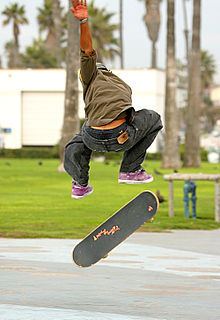
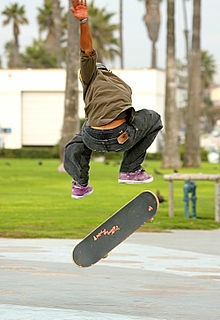
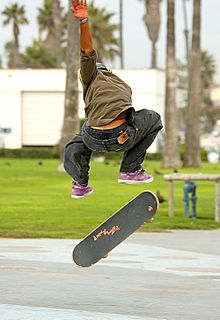
A skateboard is a type of sports equipment used for skateboarding. They are usually made of a specially designed 7-ply maple plywood deck with a polyurethane coating for smoothness and durability and wheels attached to the underside by a pair of skateboarding trucks.
The skateboarder moves by pushing with one foot with other foot balanced on the board, or by pumping one’s legs in structures such as a bowl or half pipe. A skateboard can also be used by simply standing on the deck while on a downward slope and allowing gravity to propel the board and rider. If the rider’s leading foot is their right foot, they are said to ride “goofy;” if the rider’s leading foot is their left foot, they are said to ride “regular.” If the rider is normally regular but chooses to ride goofy, they are said to be riding in “switch,” and vice versa. A skater is typically more comfortable pushing with their back foot; choosing to push with the front foot is commonly referred to as riding “mongo”, and has negative connotations of style and effectiveness in the skateboarding community.
In the early 2000s, electric skateboards have also appeared. These no longer require the propelling of the skateboard by means of the feet; rather an electric motor propels the board, fed by an electric battery.
There is no governing body that declares any regulations on what constitutes a skateboard or the parts from which it is assembled. Historically, the skateboard has conformed both to contemporary trends and to the ever-evolving array of stunts performed by riders/users, who require a certain functionality from the board. The board shape depends largely upon its desired function. Longboards are a type of skateboard with a longer wheelbase and larger, softer wheels.
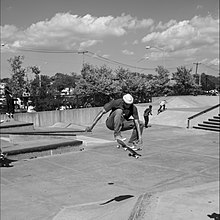
The two main types of skateboards are the longboard and the shortboard. The shape of the board is also important: the skateboard must be concaved to perform tricks.[1] Longboards are usually faster and are mostly used for cruising and racing, while shortboards are mostly used for doing tricks and riding in skateparks.



 𝔹𝕃𝕆𝔾 𝕆ℕ𝕃𝕀ℕ𝔼 𝔴𝔦𝔱𝔥 𝙆𝘼𝙎𝙋𝙀𝙍 𝙎𝘼𝙃𝙐